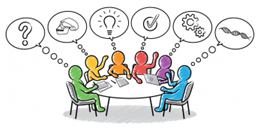
Active reading is about actively seeking an understanding of the reading in front of us. Active reading isn’t about waiting for the words on the page to jump out at us and make sense – it’s about actively going after that understanding. The opposite of active reading is passive reading. Passive reading takes much less effort, is not as interesting, and leads to less understanding.
Active reading starts before we even begin to read – by gathering information, or previewing, and asking ourselves questions about it. During reading, we can be active by noting different kinds of important or useful information as it comes up. Afterward, we can summarize, remember, repeat, form our own opinions about and reflect on the importance of what we just read. All of these activities are ways to increase our understanding of what we read.
Before (preview)
- Preview
- Come up with questions to ask while you’re reading
During (view)
- Recognize topic sentences, main ideas, key terms, transitions
- Highlight key points
- Learn vocabulary (by using context clues or by looking up definitions)
- Understand new language
After (review)
- Recall and recite (“What did I learn? What do I need to remember?”)
- Summarize (“This is mainly about…”, or “What was the big idea?”)
- “This is important because…”
- “Were my predictions correct?”
- “I think the author wants me to…”
